
6 Lessons I Learned Dry Pouring a Concrete Slab for a New Shed in the Desert During the Height of Summer
I’ve been planning on pouring a number of concrete projects from a new floor in the barn, patio areas, fire pits and, you guessed it, a concrete slab for a new shed.
I’ve set a couple of dozen fence posts using the dry pour method and I wet poured a couple of air conditioner pads after a building inspector informed me that cinder blocks weren’t adequate to pass the inspection. Neither posts or the pads had to necessarily look good.
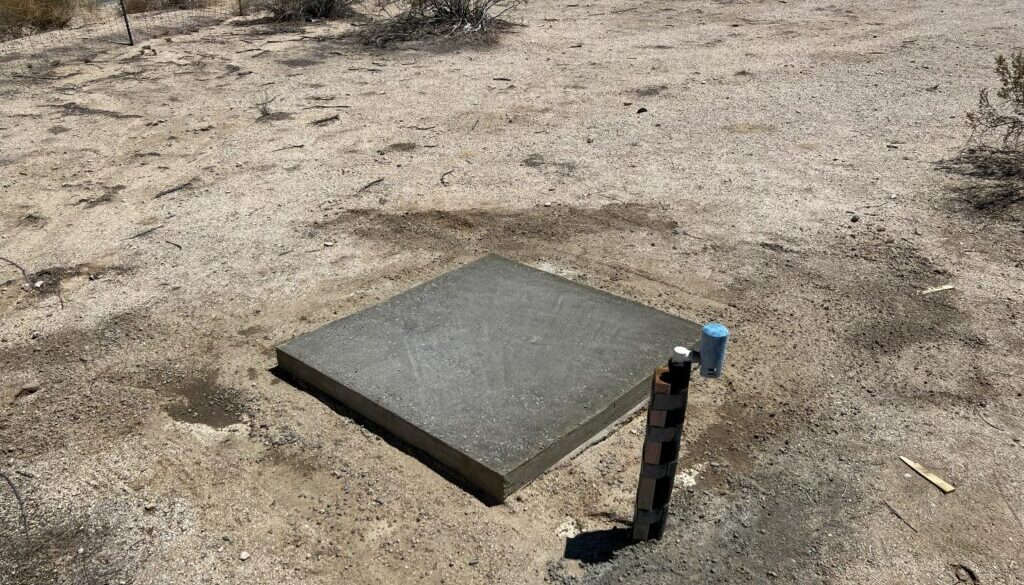
The shed foundation seemed the easiest and required the least aesthetic outcome of my future projects. The new shed pad will be covered with a shed and it only needs to be 4 foot by 4 foot.
I used an online concrete calculator to determine that I’d need 10 bags so I picked up 12. I ENDED UP USING 11.5 BAGS
I then need to create a form. I was about to run to the store and buy some 2×4’s and realized that I had an entire fence made out of cinder blocks and 2x4s so I grabbed 5 of those and put one to 48 inches minus 3 inches. I also had some deck screws so, once I pick up 12 bags of QuickCrete from HomeDepot I’ll be ready to go.
Today, bags of QuickCrete were $4.35 so the whole project will cost me less than $60.
- Lesson one, Start early in the day.
I was up at 5 AM and started prepping the site by 5:30. I had a rake, a shovel and a plan. I smoothed out a 5 x 5 foot area. Grabbed 5 2 x 4 x 10′ out of my fence and set them up using a speed square, 3 foot level and then used my drill to screw one screw in each 2 x 4. I should have pre drilled, did I mention it was early in the morning? I heard some cracking on a couple of the two by fours as I drove in the screws. Also, buy more concrete than you think you need. When you level your form, more than likely, you will raise up one or more sides of the form. When you do this you either need to fill in with sand or gravel or just dump more concrete to make the edges consistent. - Lesson two, don’t water the ground before dumping the bags of QuickCrete
Why? Well, I thought that I might not finish pouring and screeding in one day. It was 82 degrees when I started and 107 when I stopped for the day. If I had saturated the ground and the bottom of the slab would have started curing immediately and the top would not get wet until the next day.
Also, I’m in the desert, the ground is sand. Luckily it was fairly compact but the water percolates fast so even if I had wet it down It would have been barely damp by the time I finished. I then dumped 11.5 bags of concrete into the form, raked it out and used the side of the rake to tap the sides of the form. This helps settle the concrete on the edges of the slab - Lesson three, screeding sucks.
I was working alone but the area was only 4 foot square. No big deal right? Everytime I moved the 2×4 back and forth and inches it forward I’d pick up rocks and it would gouge the surface. I did this many times over the course of an hour. I got to the point of picking rocks out of the edges by the handful and recalling the advice from a YouTuber to sift half a bag of concrete prior to starting. This is a great idea. Did I do it? No. Why? I’d have to run to the hardware store and buy some screening. Next time I will.
Also, a shorter screed and perhaps a legitimate store bought screed would have worked better. My 2×4 was a 10 footer and kind of heavy. I didn’t want to cut it as I was planning on replacing it on my fence when I was done. - Lesson four, concrete loves water.
I’ve watched a number of dry pour concrete videos and many of them were afraid to water the concrete. Some of you know this, but for the rest of you, Concrete doesn’t dry it cures. Curing concrete is a chemical reaction and it needs water to penetrate and touch every ounce of concrete you pour. Of course I’m in the desert so I didn’t want the water to evaporate before the curing had a chance so I misted the pad every 15 minutes, again it was probably in the mid-90s at the time. After a couple of hours I saturated it every 30 minutes for a number of hours. By staturating I mean both the surface of the pad, the form boards and the area around the form boards by at least a foot out. I let it cure in the heat of the day up to maybe 102 degrees. A smart person would have covered the pad with plastic to slow down the evaporation. Again next time. I then went out that night and saturated it again a couple of times. The next morning, about 6:30, I saturated it a couple more times and decided to remove the form boards about 2 hours after my last watering. - Lesson five, don’t drive on it, drill into it or set anything heavy on it for at least 28 days.
Concrete takes time to cure fully. No matter what the bag says on it 3000, 4000 or 5000 PSI isn’t achieved for 28 or more days. And as a Dry Pour it may never reach those PSIs so wait. Let it fully cure and then try some anchor holes and heavy weights. I plan on using this pad as a Shed Foundation and I want to drill some holes and anchor the shed down. There’s a good chance that tightening an anchor could crack the slab even after 28 days, so I’m waiting to give it the best chance of success. If it still cracks, I’ll repair the crack and use a heavy-duty liquid nails type product to anchor the shed down, not ideal but it’ll probably work even in for the high winds out here in the desert. - Lesson six, don’t expect perfection.
I started misting well before I was happy with the finish. Knowing full well that the finish I started with is the finish I would finish with. Of course I used the paint roller trick. It helped not just smoothing out the screeding lines but it picked up some of the powder and redistributed it across the pad and covered a few gouges and rocks that were still showing.
Mixing, pouring and finishing a wet pour is much more time consuming that doing a dry pour and you still need to mist it and saturate for the then 24 to 48 hours especially in the desert. It’s certainly not the best solution for all concrete projects but it sure is easy, requires less manpower and you can take your time and even change the forms during the project.
And, yes! I’ll be doing more of them here at Star Dune Ranch.
I am sure these lessons will help you on your next Dry Pour concrete pad project. If you want to see an update on this pad and shed project like, follow and subscribe. We’ve got a lot of upcoming projects and need to get done here at Star Dune Ranch. We also have an Airbnb that you can stay at. I’ll leave links in the description.